Sales per visitor is the average amount a store sells for every person who walks in: total sales value divided by footfall over the same period. If a store takes £1,000 on a day when 181 people enter, its sales per visitor is £5.53. It calculates what an individual visitor is worth to the store, whether or not they bought anything.
It is not the same as average transaction value. Average transaction value divides sales by the number of transactions, so it only describes the people who actually made a purchase. Sales per visitor divides by everyone who came in, so it carries the conversion rate inside it.
Why sales per visitor is useful
Sales per visitor is the product of two things a store can work on separately: the share of visitors who buy, and how much each buyer spends. The formula can also be calculated as:
Sales per visitor = conversion rate × average transaction value.
In the example above, 13.7% of visitors bought and the average sale was £40.41, which gives £5.53 per visitor. This breakdown is what makes the number useful. If sales per visitor falls, the two parts tell you where to look: a lower conversion rate points to the store, the range, service or price; a lower transaction value points to the basket. A store can post a rising conversion rate and still earn less from each visitor if baskets have shrunk, and sales per visitor is the metric that catches it.
It also puts a price on a visitor. Once you know a visitor is worth £5.53, the question of whether a window display, a promotion or a longer Saturday opening is worth it becomes arithmetic rather than opinion, because footfall can be converted into expected sales. And it compares stores fairly: a high-street branch and a retail-park branch with very different traffic can be viewed side by side on what each visitor was worth.
Per passer-by, per visitor and per transaction
The same sales figure (total revenue) can be divided by any level of the conversion funnel, and each division answers a different question.
| Measure | Formula | What it tells you |
|---|---|---|
| Sales per passer-by | Sales ÷ passers-by | What the store earns from each person who could have come in: the value of its location and frontage. |
| Sales per visitor | Sales ÷ footfall | What the store earns from each person who did come in: the value of the store itself. |
| Sales per transaction | Sales ÷ transactions | What each buyer spent: the value of the basket. |
The three are linked by the same ratios that link the funnel: sales per passer-by is capture rate × sales per visitor, and sales per visitor is conversion rate × sales per transaction. In the example, a capture rate of 39.4% turns £5.53 per visitor into £2.18 per passer-by. Read together, they show whether a change in revenue came from the street, the door or the till.
Getting the number right
Sales per visitor is only as good as its denominator. Footfall has to be de-duplicated, so that a visitor who steps out to take a call and comes back in is counted once, and it has to cover the same doors and the same hours as the sales data. Sales taken online for collection in store, and refunds, should be treated consistently from one period to the next, or the number moves for reasons that have nothing to do with the shop floor. Compare like with like: a destination store with few visitors and large baskets will always show a higher figure than a convenience store, and the useful comparison is a store against its own history or against stores of the same kind.
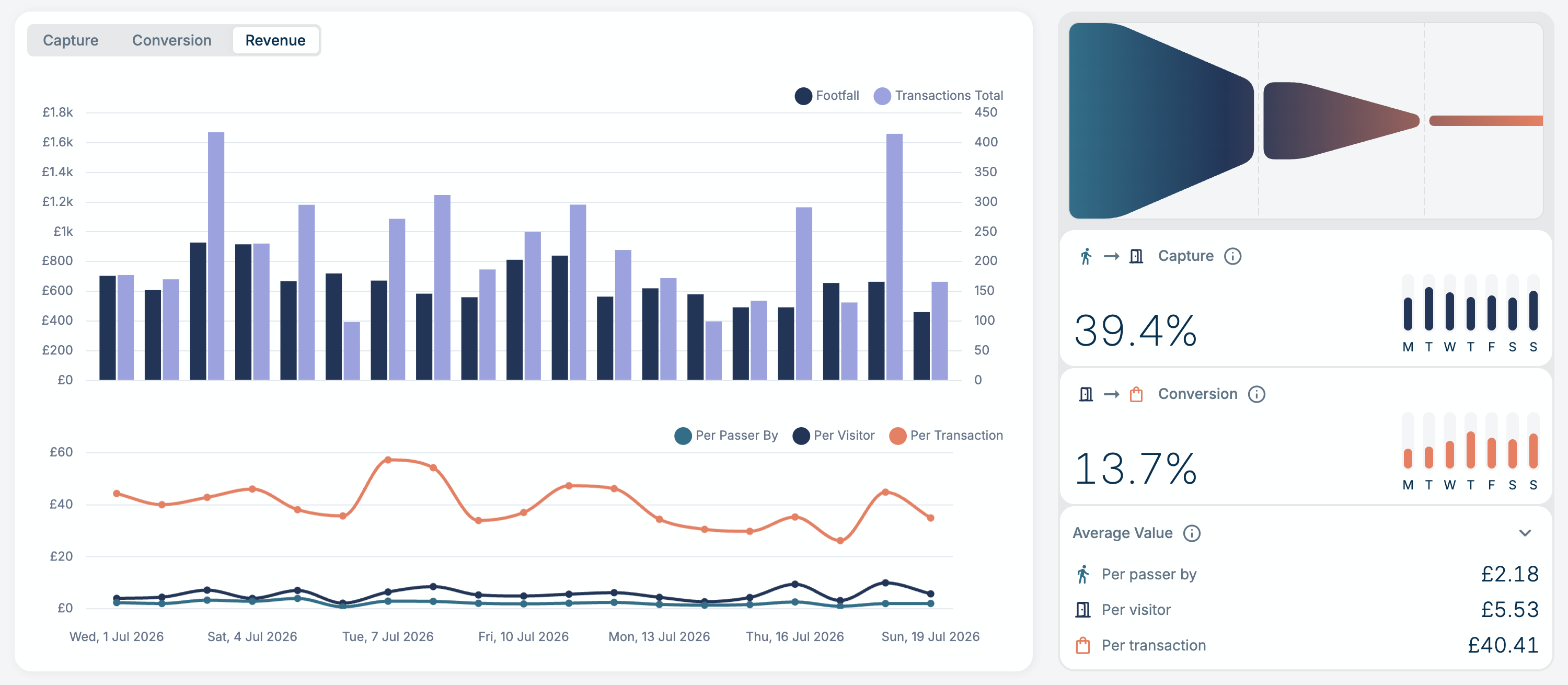
The Glimpse Portal reports sales per passer-by, per visitor and per transaction from the retailer's transaction feed joined to validated footfall and passer-by counts, day by day and as a period average, alongside capture rate and conversion rate, so that a change in any one of them can be read against the others.